
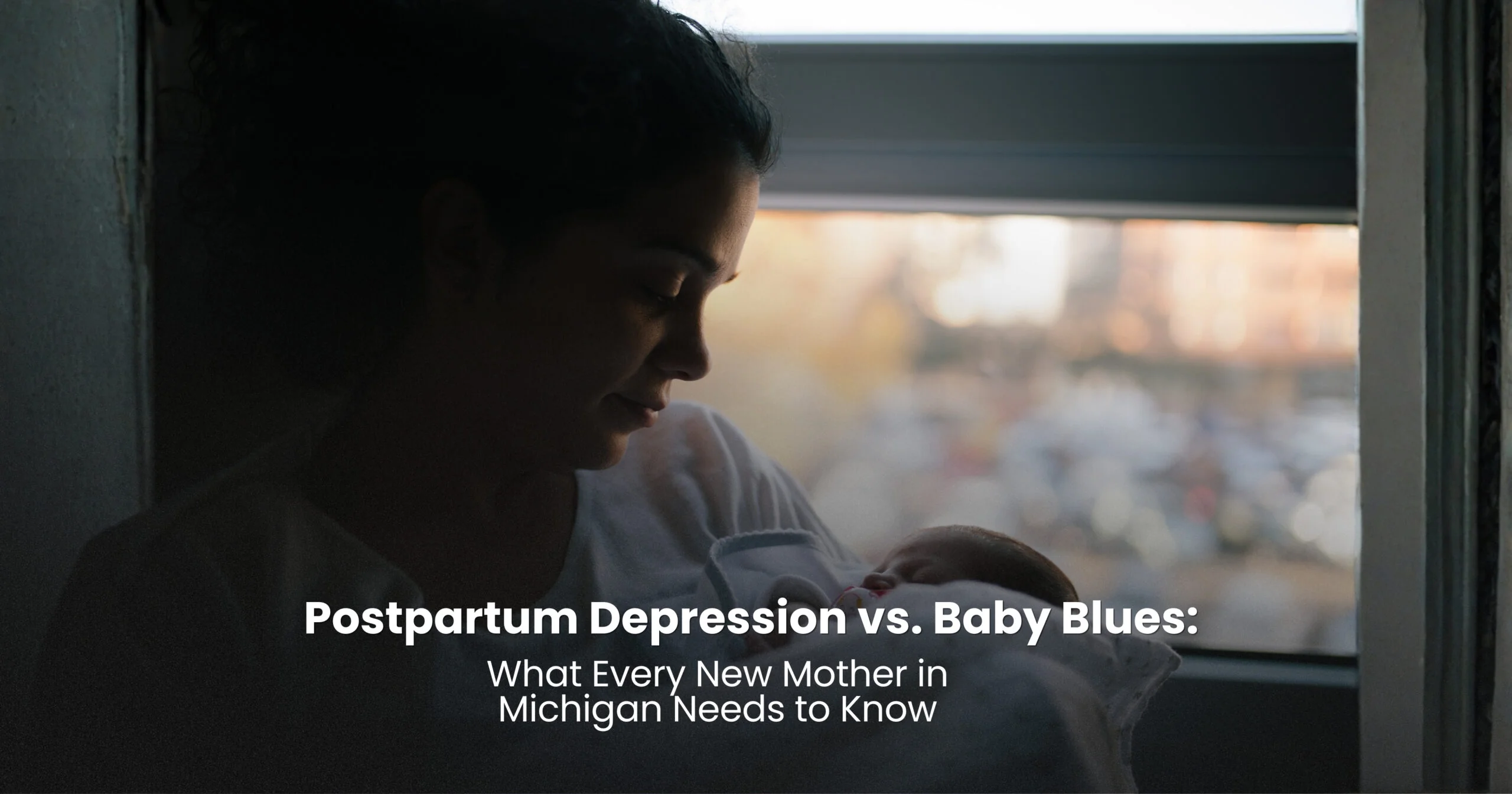
It’s 3 a.m. The house is quiet except for the sound of your baby feeding. You’ve been awake for hours. You’re holding this person you’ve waited months to meet, and you’re crying. Hard. And you don’t know why.
You tell yourself you should feel happy. You wonder if something is wrong with you. You wonder if you’re already doing this wrong.
You’re not. And you’re not the only person who’s sat in the dark feeling exactly this way.
A lot of new mothers are afraid to ask the question out loud: Is this normal? Is something wrong with me?
Let’s actually answer it.
The First Two Weeks: What’s Normal (Baby Blues Explained)
After you give birth, estrogen and progesterone levels drop sharply. These hormones were elevated throughout pregnancy, and their sudden decline is real, physiological, and happens to almost everyone. Add disrupted sleep, physical recovery, and a life that has just changed in ways you couldn’t fully anticipate, and you have the conditions for what’s called the baby blues.
The baby blues usually show up within two to three days of delivery. You might find yourself crying with no clear trigger, snapping at your partner over something small, lying awake when the baby is finally sleeping, or feeling shaky and overwhelmed in a way that’s hard to explain.
According to ACOG, somewhere between 70 and 80 percent of new mothers experience this.
That number matters. It means the baby blues are not a sign of weakness or poor mental health. They are a predictable response to a dramatic hormonal shift. And they pass on their own, typically within two weeks.
During this time, sleep when you can, let people help when they offer, and try to eat. You don’t need to push through on your own.
When It Doesn’t Go Away: Recognizing Postpartum Depression
If two weeks pass and the sadness, anxiety, or emotional numbness don’t lift, or they worsen, that’s when it may be postpartum depression (PPD) rather than baby blues.
The National Institute of Mental Health estimates that about 1 in 8 women experience PPD. It’s a medical condition, not a reflection of how much you love your baby or how prepared you were.
PPD looks different from ordinary new-parent exhaustion. Some things to watch for:
- Sadness or emptiness that persists beyond two weeks
- Pulling away from your partner, family, or your baby
- No longer caring about things you usually enjoy
- Difficulty feeling connected to your newborn; many mothers find this the hardest symptom to admit
- Guilt or a sense of failure that doesn’t let up
- Intrusive thoughts you don’t want and would never act on
- Fatigue that a full night’s sleep doesn’t fix, when you can get one
- Trouble concentrating or making ordinary decisions
- Changes in appetite, eating much more or much less than usual
- Unexplained headaches, stomach problems, or body aches
If you recognize yourself in that list, what you’re experiencing has a name and it responds to treatment. That’s what matters right now.
Postpartum Anxiety: The Condition That Gets Less Attention
Postpartum depression gets most of the coverage, but postpartum anxiety is just as real and affects a significant number of new mothers.
Postpartum Support International puts the estimate at 10 to 15 percent, and many cases go unrecognized because anxiety doesn’t look like sadness.
With postpartum anxiety, you might feel a constant, low-level dread that something bad is about to happen. You may be unable to rest even when your baby is asleep. Your thoughts race. Your chest tightens. You go back to check on the baby a seventh time even though you just checked. You replay conversations and decisions and possible disasters on a loop.
Some women have postpartum anxiety without any depression. Others have both. In either case, it’s not you being overly worried or a bad mother. It’s a condition, and it responds to treatment the same way PPD does.
If your mind won’t slow down and your body is constantly braced for something, that’s worth talking to someone about.
Risk Factors: Why Some Women Are More Vulnerable
PPD can happen to any new mother.
The CDC’s data on postpartum depression is clear that it cuts across income levels, age groups, and backgrounds. That said, certain factors do raise the likelihood:
- A personal or family history of depression or anxiety
- A previous experience with PPD after an earlier pregnancy
- Financial stress, relationship strain, or little practical support at home
- Complications during pregnancy or delivery, including a traumatic birth or time in the NICU
- Difficulty breastfeeding
- Geographic or social isolation
- A history of trauma
None of these are within your control, and none of them are your fault. They’re also not a guarantee that PPD will happen. They just mean that paying attention to how you’re feeling and reaching out early is worth doing.
What Postpartum Depression Is Not
There’s a lot of shame wrapped up in PPD, and most of it is misplaced.
PPD is not evidence that you don’t love your baby. Many women who are in the middle of it love their children deeply. The pain and the love coexist, which is part of what makes it so disorienting.
It’s also not a sign of being unfit to parent.
The Office on Women’s Health is direct on this point: PPD is caused by a combination of hormonal, physical, and environmental factors. Nobody chooses it.
PPD is also not the same as postpartum psychosis, which is a rare and distinct condition involving breaks from reality. The intrusive thoughts that sometimes come with PPD, the ones that horrify you the moment they appear, are a documented symptom of the illness. They are not urges. They are not plans. They are symptoms, and they’re more common than most mothers know.
Asking for help doesn’t mean you’ve failed. It means you recognized something was wrong and did something about it.
Getting Help In Michigan: What Your Options Look Like
If you’re in Southwest Michigan and wondering at 2 a.m. whether what you’re feeling is “bad enough” to get help for, it is. You don’t have to be in crisis to deserve care.
If you want a place to start before booking an appointment, Postpartum Support International offers a free screening tool and a staffed warmline with trained volunteers available around the clock.
When you’re ready to work with someone professionally, our Women’s Behavioral Health program is designed for exactly this stage of life. We take into account whether you’re breastfeeding, what your schedule actually looks like, and what you’ve tried before.
Treatment for postpartum depression generally takes one of a few forms, used alone or together depending on what fits you.
Therapy, particularly cognitive behavioral therapy (CBT), is a first-line treatment for PPD. The American Psychological Association recognizes it as well-supported by clinical evidence. It’s not about being told to think positively. It’s about identifying the thought patterns that are making things harder and working through them with someone trained to help.
Medication is another option, and for mothers who are breastfeeding, there are medications with established safety records. Our psychiatry team will talk through every option with you before anything is prescribed. You decide what feels right.
Some women do well with therapy alone. Others benefit from medication alongside it. There’s no single correct approach, and finding what works for you is the whole point.
What Happens If PPD Goes Untreated
This isn’t meant to be alarming, but it’s worth knowing.
Unlike the baby blues, postpartum depression doesn’t typically fade on its own.
NIMH’s research shows that without treatment, PPD can persist for months or longer, and it raises the risk of future depressive episodes. It can also strain the early bond with your baby during a period when that connection is forming.
Getting treatment for PPD is something you’re doing for yourself and for your child. The good news is that treatment works. Most women who get appropriate care see real improvement, often within a few weeks of starting.
You’ve Already Done The Hard Part
You read this far. That matters.
Whatever you’re carrying right now, the exhaustion, the guilt, the numbness, the fear that you’re somehow doing this wrong, you’re not broken. You’re a mother who is struggling and who deserves support.
Our Women’s Behavioral Health team in Kalamazoo is here to help, with private, judgment-free care from people who work specifically with women through this.
Request a new patient appointment with our Women’s Behavioral Health program. You can do it from your phone right now.
If you want to read more first, our Women’s Behavioral Health page has more detail, or you can browse our full psychiatry services.
You don’t have to keep sitting with this alone.
Frequently Asked Questions
How do I know if I have the baby blues or postpartum depression?
The main thing to watch is how long it lasts. Baby blues usually show up within a few days of delivery and clear up within two weeks. If you’re still struggling after that two-week point, or if symptoms are getting worse rather than better, it’s worth talking to a provider. PPD also tends to be more intense than baby blues and doesn’t lift with rest or time the way baby blues do.
Can PPD start months after the baby is born?
Yes. PPD can begin any time in the first year postpartum. Some women don’t notice it until they go back to work, stop breastfeeding, or hit a hard week several months in. If you’re six months postpartum and still not feeling like yourself, that’s not something to dismiss. The timeline doesn’t have to be the first few weeks.
Is postpartum anxiety different from postpartum depression? Can you have both?
They’re separate conditions, though they overlap often. Depression tends to show up as sadness, low energy, and withdrawal. Anxiety tends to show up as excessive worry, physical tension, and racing thoughts. A lot of women experience them together. Either one warrants treatment, and you don’t need to be experiencing depression specifically to reach out for help.
Do I have to take medication? I’m breastfeeding.
No. Therapy alone is effective for many women, and it’s a legitimate starting point. If medication ends up being part of your care plan, there are options with well-established safety profiles for breastfeeding mothers. Our team will walk through what those are and won’t recommend anything you haven’t agreed to. The decision is yours.
What if I’m afraid people will judge me, or that someone will take my baby away?
This fear keeps a lot of women from getting help, and it’s worth addressing directly. Seeking mental health treatment is not grounds for child protective services involvement. Reaching out for care actually shows the kind of self-awareness and follow-through that good parenting involves. Our providers are here to support you through this, not to evaluate you.
Can partners get postpartum depression too?
They can. NIMH’s resources on PPD acknowledge that partners, fathers in particular, can experience depression in the postpartum period. If your partner has seemed withdrawn, irritable, or unlike themselves since the baby arrived, that’s something worth paying attention to. We see families, not just individuals.
How long does treatment usually take?
It varies. Many women notice a real difference within four to eight weeks of starting treatment. Some finish a course of therapy in a few months. Others find ongoing support helpful beyond that. The timeline is different for everyone, and there’s no pressure to be done by a certain point.
How do I get started in Kalamazoo or Southwest Michigan?
The fastest way is to submit a new patient request through our website. You can do it from your phone at any hour. If you’d rather look around first, our Women’s Behavioral Health page has more information. You can also call us during office hours if you’d prefer to talk to someone before booking.
Kalamazoo TMS & Psychiatry serves mothers across Southwest Michigan, including Kalamazoo, Portage, Battle Creek, and St. Joseph. Our Women’s Behavioral Health program offers care for postpartum depression, postpartum anxiety, and other women’s mental health needs.
If you’re having thoughts of harming yourself or your baby, please call or text 988 to reach the Suicide & Crisis Lifeline, or go to your nearest emergency room.


