
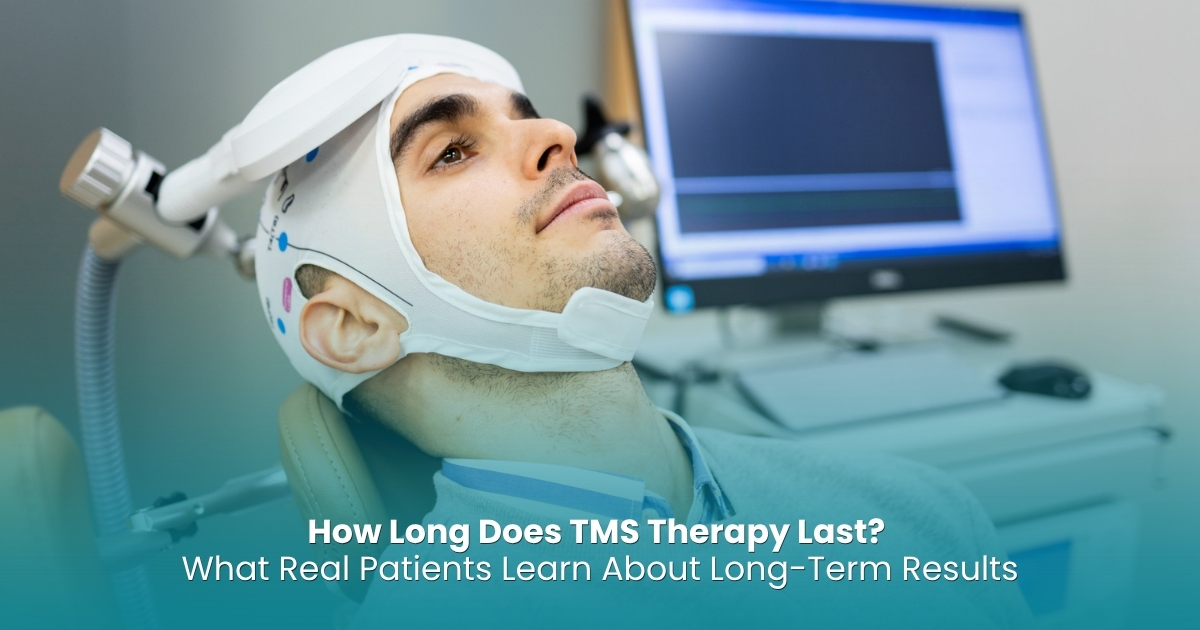
If you’re weighing TMS for depression, one question tends to sit at the center of everything: Will the results actually hold? You’ve done the research. You know TMS works for many people. What you want to know is whether you’ll still feel better in a year, or whether the improvement fades and you’re back where you started.
That concern is worth taking seriously, and the research gives a more encouraging answer than most patients expect. Let’s uncover how long does TMS therapy last in terms of treatment duration, how long the results typically persist, what factors shape your outcome, and when maintenance sessions make sense.
What a Standard TMS Course Looks Like
A standard TMS course at Kalamazoo TMS runs 5 sessions per week across 4 to 6 weeks, totaling around 30 to 36 sessions. No anesthesia, no sedation, and no recovery time needed afterward. Most patients drive themselves home and return to their day.
That’s a meaningful difference from antidepressants, which require daily dosing to maintain their effect. TMS is a finite course of treatment. Once you complete it, many patients find the brain changes it produces continue working without ongoing daily intervention.
For a fuller explanation of the science behind the treatment, see how TMS therapy works.
How Long Does TMS Therapy Last? What the Data Shows
The question of how long does TMS therapy last has been studied in large-scale clinical follow-ups, and the results are worth knowing before you make a decision.
The NeuroStar clinical registry, one of the largest naturalistic studies of its kind, followed 307 patients across 42 practices for a full year after they completed a TMS course. At the end of treatment, 62% had achieved meaningful symptom improvement and 41% were in full remission. At 12 months, those numbers held: 68% still showed improvement and 45% remained in full remission. For a population that had already failed multiple antidepressant medications, that kind of durability is clinically significant.
A separate follow-up study by Dunner and colleagues tracked 120 patients who had responded to TMS. Of those, 62.5% continued to meet response criteria across the full year of follow-up without requiring a new full treatment course.
So when asking how long does TMS therapy last for depression specifically, a reasonable answer for patients who respond is: one year or longer, for most. Some patients go considerably further without needing to return for retreatment.
What shapes how long your results last
Several factors influence durability:
- Severity and chronicity of depression. Patients with a shorter episode history before treatment tend to hold their results longer than those with decades of recurrent depression.
- Prior medication failures. TMS is cleared by the FDA specifically for patients who haven’t responded to antidepressants, and it remains effective even in this group. Patients with more complex treatment histories may have a narrower response window.
- Completing the full course. Stopping early or skipping sessions reduces outcomes. The brain needs the full repetition to consolidate the changes TMS produces.
- Lifestyle factors. Continued therapy, sleep hygiene, physical activity, and social connection all support the neurological changes TMS initiates.
- Maintenance sessions. Covered in the next section.
TMS Maintenance Sessions: What They Are and Who Needs Them
Even patients whose results last well past a year sometimes notice early warning signs of depression returning: disrupted sleep, lower energy, a gradual flatness in mood. Maintenance TMS is designed for exactly that scenario.
Maintenance sessions are typically scheduled monthly or on an as-needed basis when a patient recognizes early symptom return. They’re not a signal that the initial treatment failed. Many patients with recurrent depression use them the same way a person with chronic back problems uses occasional physical therapy: the initial treatment did the heavy lifting, and the check-ins protect what was gained.
Patients most likely to benefit from maintenance TMS include those with a history of multiple depressive episodes, those who reached full remission during their initial course rather than partial response, and those working to reduce or avoid long-term antidepressant use.
On the question of insurance coverage: most major insurers cover an initial TMS course for patients who meet clinical criteria. Maintenance coverage is more variable. The team at Kalamazoo TMS can verify your benefits before you start. See our insurance information here.
What Real Patients Experience
Clinical percentages can feel abstract. What tends to land with patients considering TMS is what other people’s timelines actually looked like.
Some patients notice changes as early as week two or three, typically in sleep quality or brief windows of lifted mood. Others don’t feel meaningfully different until week five or six, and some continue improving for several weeks after the course ends. The variation is real and worth knowing in advance, because patients who expect overnight results sometimes disengage too early.
At the 12-month mark, 83% of NeuroStar TMS patients reported continued relief from depression, and 62% had experienced complete remission according to long-term outcome data. Among the patients who needed a maintenance session or two to sustain that, most described the maintenance commitment as minor compared to daily medication management.
Our physicians are happy to share what they’ve seen across the more than 7,000 TMS sessions administered at Kalamazoo TMS.
When a Second Full Course Makes Sense
How long does TMS therapy last varies by person, and for some, a second full course becomes appropriate after 12 to 18 months. A significant return of depressive symptoms, sustained deterioration rather than a rough week, is typically the trigger for discussing re-treatment. Research supports it: response rates to a second TMS course are similar to the first. Returning for a second course is not evidence that the treatment stopped working. For many people with recurrent depression, it is simply part of managing a chronic condition with a tool that can be used more than once.
If your depression has been resistant to multiple antidepressants and you’re thinking about whether TMS is the right next step, our full-spectrum psychiatric services page covers the full range of treatment options, including Spravato® and Spravato (Spravato®) for patients who need faster-acting options.
The First Step
The most common thing patients say after completing TMS is that they wished they had asked about it sooner. Understanding how long does TMS therapy last is useful context. Knowing whether you’re actually a good candidate requires a conversation with a physician.
At Kalamazoo TMS, evaluations are no-pressure. We review your treatment history, discuss what outcomes look like for patients in similar situations, and give you an honest read on whether TMS makes sense for you. Schedule your initial evaluation here.
Frequently Asked Questions
How long does one TMS session take?
Between 20 and 40 minutes at Kalamazoo TMS, depending on the protocol. The NeuroStar system we use delivers 3,000 magnetic pulses in 19 minutes.
How long does the full TMS treatment course last?
Approximately 4 to 6 weeks, with daily Monday-through-Friday sessions. Most courses total 30 to 36 sessions.
How long does TMS therapy last for depression?
For patients who respond well, improvement typically holds for 6 months to over a year. In the NeuroStar 52-week registry study, 68% of patients maintained improvement at 12 months.
Does TMS work permanently?
Not always, but for many patients the results are genuinely durable. Some people maintain improvement for years without re-treatment; others use maintenance sessions or a second course when symptoms return.
How often are TMS maintenance sessions needed?
It varies by patient. Monthly sessions or as-needed visits when early symptoms appear are the most common approaches.
Can TMS results wear off?
They can, particularly for patients with recurrent or severe depression. Having a maintenance plan discussed in advance, even if you never end up needing it, is something worth raising at your initial evaluation.


