
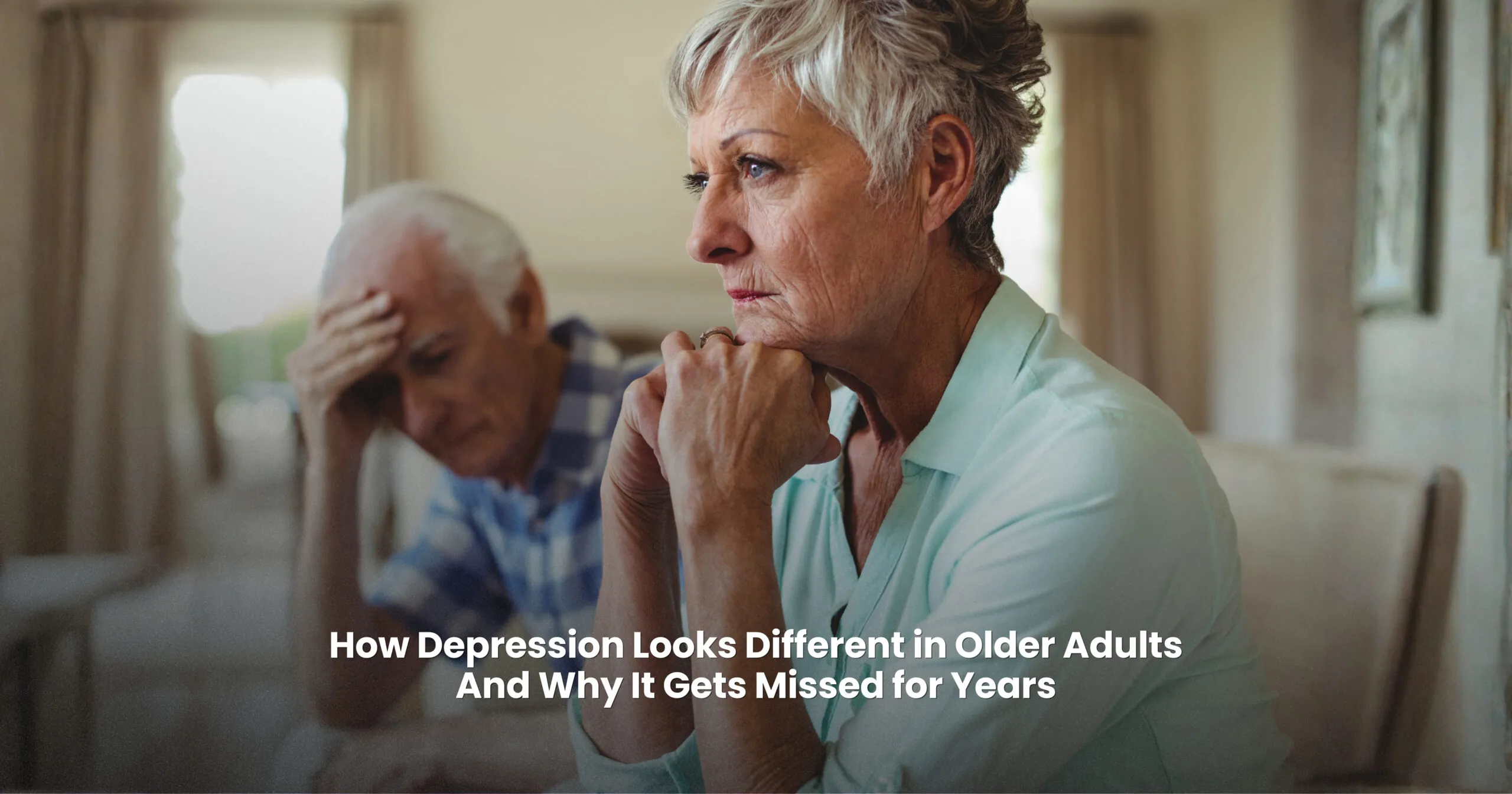
Most people have a mental image of what depression looks like: persistent sadness, crying, withdrawing from life. That picture is incomplete at any age, but in older adults, it can be so far off that depression goes unrecognized for months or years at a time.
This is not a rare problem. The National Institute of Mental Health reports that depression affects more than 6 million Americans over age 65, yet it remains one of the most underdiagnosed conditions in that age group. Older adults, their families, and even their physicians often mistake the signs for normal aging, grief, or physical illness and treatment never happens.
If you’re an adult child watching a parent change, or an older adult who hasn’t felt like yourself in a long time, this is worth reading carefully.
Why It Gets Missed
Depression in later life often goes undetected for reasons that have nothing to do with negligence.
Older adults grew up in an era when mental illness carried real stigma. Many genuinely believe that feeling low is something you push through, not something you bring to a doctor. They may not describe emotional symptoms at all, and they may resist anything that sounds like a mental health label.
At the same time, older adults typically see doctors more frequently than younger people, but those appointments tend to focus on physical conditions like blood pressure, diabetes, mobility and medications. A physician with fifteen minutes may not notice that a patient has grown quieter or more withdrawn over the past year. Geriatric depression symptoms rarely come up unless someone specifically asks about them.
There’s also genuine overlap between depression and the physical realities of aging. Fatigue, poor sleep, and reduced appetite are symptoms of depression, but they’re also common in people managing chronic pain, heart disease, thyroid conditions, or any number of other health issues. Sorting out what’s physical and what’s emotional requires careful attention that standard primary care visits don’t always allow.
What Late-Life Depression Actually Looks Like
This is where the standard depression checklist breaks down. In older adults, the emotional component is frequently secondary or absent altogether. What tends to surface instead is a cluster of physical and behavioral changes that look like something else entirely.
Persistent physical complaints without a clear medical cause are one of the most common presentations. Headaches, digestive problems, generalized body aches, and fatigue that doesn’t improve with rest can all be depression expressing itself somatically. When workups come back normal, these complaints are sometimes dismissed. They shouldn’t be.
Memory problems and difficulty concentrating create particular confusion because families immediately worry about dementia. Doctors order cognitive testing. The depression goes untreated. In some cases, treating the depression improves cognition significantly, an outcome that would never happen if the underlying problem were structural dementia.
Many depressed older adults describe not sadness but a flatness. Hobbies they genuinely enjoyed for decades feel like nothing. They stop calling friends, not because they’re sad but because it just doesn’t seem worth the effort. This loss of interest or anhedonia in clinical terms, is one of the most consistent geriatric depression symptoms, and it’s easy to mistake for personality change or simply “getting older.”
Increased irritability or agitation is another presentation families often misread. A parent who has become inexplicably difficult to be around may be depressed, not simply cantankerous. Depression in older adults frequently looks more like chronic frustration or low tolerance than it does like visible sadness.
Pulling back from family, skipping events they used to attend, and stopping communication with friends are all worth noting. Beyond being a symptom, isolation worsens depression over time and makes it harder for anyone to spot the change.
Slowed movement and speech, taking longer to respond, moving with less energy and speaking with flatter expression are documented geriatric depression symptoms that are easy to attribute to arthritis, medication side effects, or general aging.
Any expression of feeling like a burden to family, wishing things were over, or references to death that go beyond casual acknowledgment deserve a direct follow-up conversation. This is not a normal part of aging and should never be treated as one.
The Conditions That Mask It Further
Several medical conditions common in older adults produce symptoms that overlap with depression, making diagnosis harder. Hypothyroidism causes fatigue, cognitive slowing, and low mood. Anemia does too. Vitamin B12 deficiency can produce depression-like changes and cognitive effects. Parkinson’s disease includes depression as a clinical feature, not just an emotional response to diagnosis. Chronic pain and depression frequently co-occur, and each condition can worsen the other.
Medications are another variable. Some blood pressure drugs, corticosteroids, and benzodiazepines can contribute to depressive symptoms. Older adults often take several medications at once, and the cumulative effect on mood is difficult to track without someone reviewing the full picture.
This is why geriatric psychiatry is a distinct discipline, one that accounts for the complexity of aging, multiple chronic conditions, and the full range of what depression looks like in later life. Our geriatric psychiatry and memory disorders care at Kalamazoo TMS is built around exactly this kind of comprehensive picture.
Why Treatment Matters and Why It Works
Late-life depression is treatable. That point gets lost in the conversation about how difficult it is to detect.
Cognitive behavioral therapy is effective in older adults and is well-supported as a first-line approach. Antidepressant medications help many patients, though medication management in older adults requires attention to dosing and interactions that isn’t always applied in standard care. Exercise has a well-documented effect on depression. Social engagement and structured activity matter too.
The CDC’s data on depression and older adults is direct on this: depression is not a normal part of aging, and treatment produces measurable improvement in quality of life, functional ability, and physical health. Older adults who receive appropriate treatment do better across the board.
What blocks treatment is almost always detection. Which is why recognizing what to look for matters so much.
When to Reach Out
If you’re an adult child and something has shifted in your parent over the past several months, that’s worth pursuing. You don’t need a clear diagnosis to ask for an evaluation. You need a concern.
If you’re an older adult reading this yourself: if you’ve been feeling flat, exhausted, physically unwell without explanation, or less interested in your own life than you used to be, that’s worth bringing to a doctor who has experience in senior mental health. It is not a weakness to do so, and it is not inevitable.
At Kalamazoo TMS & Behavioral Health, we work with older adults and their families across Michigan to identify what’s going on and find a treatment path that fits the patient. You can learn more about our full range of care options on our services page or reach out directly to talk through next steps. A geriatric evaluation is a starting point, not a verdict.


